November 26, 2026 (Thursday)
<At Tokyo Racecourse>
Weather: Fine
Going: Standard (dirt course), Good to Firm (turf course)
- cantered 1/2 lap, galloped 3/4 lap left-handed on turf course, ridden by Mickael Barzalona
(in tandem with accompanied horse Eliman)
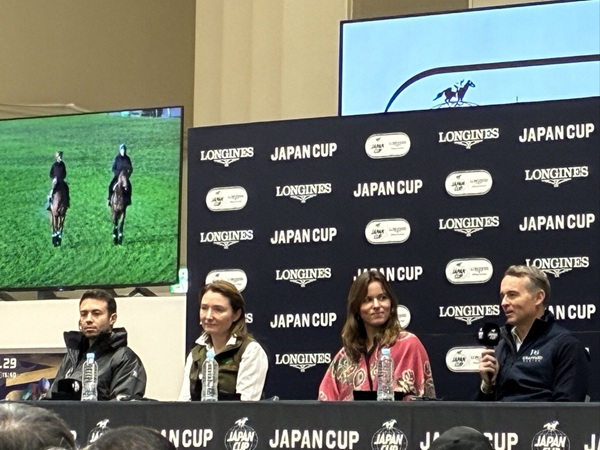
Owner Representative (OR): Nemone Routh (Aga Khan Studs)
Owner Representative (OR): Sara Boyden (Aga Khan Studs)
Trainer (T): Francis-Henri Graffard
Jockey (J): Mickael Barzalona
Q: Can you tell us what your horse has done in training since his arrival in Japan and how you felt about his workout today?
T: The horse traveled last week, and the team was very pleased with his journey to Japan. Obviously, he knows the place very well, so his condition is really good. His weight has been really good, and he's eating well. We have been really happy with the condition of the horse since he arrived.
This morning, we did a little work on the grass just to keep him focused on his work. He went the way I wanted him to be, and he didn't have a hard blow-up after the work. So, I think the horse is ready mentally and physically for Sunday.
Q: There is obviously a lot of expectations from the fans for a consecutive win. Can you share your expectations or aspirations regarding this?
T: Last year was just incredible. We were over the moon.
It has always been in the back of our minds to come back to Japan to try to do it again.
But it was very hard last year, and I think this year is going to be very hard too. The horse has been in very good shape, and he will try to defend this title as much as he can. It's very good for the racing fans to see him again this year and try to do something that is nearly impossible to do. But he's a champion, and I'm very pleased with his condition. So, I cross my fingers.
Q: I have the impression that his positioning in his races are further back during this season than in his races before that. Sure enough, last year, the race was run at an extremely fast pace and Calandagan won charging from behind. This year, we predict the pace to be perhaps much slower and if this is the case how do you think you will handle such situations this time? Will your tactics change accordingly?
A: We know he’s always a little bit slow from the start. We always used to respect that, and he’s always used to give us a lot in the end. So, we’ll see with the draw. We’ll see how the pace will be from the start. I'm pretty sure that's his way to race. He's been proving that for two years now. That's the best way to ride him. I think that's probably the tactics we're going to decide after the draw, and we'll see all the possibilities.
Q: You said that the morning before the race last year, you thought it was maybe unfair for the horse to ask him something nearly impossible, then after the race, you said it was a huge push and you were not sure you would come back again this year. What made you decide to come again?
A: Last year was a very hard day emotionally. At the beginning of the day, I was very stressed, and we felt a lot of pressure. But we proved that it was possible to do it.
And now we have the experience also. So, I think that's why we planned the season for another try in the Japan Cup.
As you said, it's always a very hard race at this level. We proved it was possible in the end, and I think it gave the idea to a lot of people to try.
Q: Do you think you will have less pressure this year?
A: Well, I don't think I will have less pressure. I saw with Daryz in the Prix de l'Arc de Triomphe, the pressure was different. When you defend your title, you have pressure. At least we have the experience, and we have done it once.
So, it's probably less, but we always want things to go the right way.
Q: You've had amazing success in Japan. We just saw it the other day with Erdenali. What has training over here taught you? What have you learned from the experiences you've had while in Japan?
A: I think since I started training, I loved to travel and I’ve gained a lot of experience.
So, I think now I know how to approach these big international races and how to prepare them at home first, and then how to travel and how to adapt the work when we are on site.
Erdenali was another challenge because he had to do like a week quarantine and move again to another place. So, it was harder but I think my team knows what to do now, and we have a good system in place. The experience is really helpful now.
Also, the feeling we have during the week before the race on site, how we can adapt the work and what to do. For example, this week, we had the question of whether we should go on the grass yesterday or today. We adapted this decision during the week.
We have a lot of experience now traveling, and it seems to work.
Q: What do you admire most about racing in Japan and Japanese racing?
A: The organization is just perfect. Every detail is important. The way the racing fans approach the races and everything. Race day was very, very special last year.
You have to respect the Japan Racing authorities and the racing fans, the way they run the industry. It's wonderful, and the racing experience was very special last year.
I really wanted to come back and try to do that again. Kyoto last week was unbelievable. You need such a good horse for such a challenge, and when it works, it's a real pleasure.
Q: If Calandagan was to win on Sunday, would that be the highlight of your career?
A: It would be one of them.
I mean, it's my job, and its big challenges. We expose ourselves a lot.
But I think it's the sport. You want to see the best horses meet in the biggest racing event of the year.
The Japan Cup is a very, very special race, especially at this time in the calendar.
For Calandagan, it would be wonderful because he has been an amazing horse for the whole team, and he's responding well every time we challenge him.
I hope it goes well for him because he deserves all the recognition.
Q: You mentioned that you worked him a little harder this year than last year in training. Any reason for that?
A: He did a good piece of work, but as you saw, it was not a strong piece of work.
It's just for the horse to be happy and to stretch his legs a little bit on the turf.
His preparation has been done completely a couple of weeks before the challenge, so the horse is ready, and it was just to keep him focused for Sunday.
- cantered, galloped 1-1/4 laps left-handed on turf course, ridden by Christophe Soumillon
(in tandem with accompanied horse Ame d’Or)
Owner (O): Philip Baron Von Ullmann
Trainer (T): Francis-Henri Graffard
Jockey (J): Christophe Soumillon
Q: Can you tell us what your horse has done in training since his arrival in Japan and how you felt about his workout today?
T: I’m very happy with the condition of Goliath. He traveled really well. The team here is very pleased with him. We knew before he left that he was in very good shape, and so the journey went well. We couldn't be happier with the condition of the horse.
Q: Can you tell us why you came to choose the Japan Cup again after his challenge in this race the year before last, and also how you came to pre-register him for the Arima Kinen as well?
T: The experience two years ago, I mean, he ran really well. Also, the race was very tactical, bizarrely, two years ago. But we were pleased with his run.
The program went differently last year for him, so we didn't come to Japan. But this year, after the win in Germany, we saw that we were coming back to try again the Japan Cup, and at the back of our heads, we were planning to stay focused to give him a try in the Arima Kinen.
Q: How do you determine if a horse is suited to Japanese racing and why did you think Goliath was one of those horses?
T: Obviously, the races here are very, very strong and very hard to win. But I think my horse has more experience.
He's very strong this year. Mentally, he's a horse that you need to keep happy. And I think this year, especially this autumn, he's really blossoming and coming really well into himself.
We know also he likes racing on right-handed tracks. That's why the Arima Kinen can be an interesting goal for him. And as I said, his run two years ago was a good run. I think with more experience and Goliath in very top form, he can run a big race.
Q: The horse seems to be in very good form. How did you feel riding him today and can you tell us what you think about the other runners in the field?
J: Yes, like you say, this morning he was in great shape. Moving really well. He looks more relaxed and stronger than two years ago when he came here for the first time.
Like Francis just said before, unfortunately the Japan Cup went very slow two years ago, and he didn't jump out of the gates as good as he does normally. So we were not in the best position that day, but the horse ran really well.
I think on Sunday it's going to be a very different race. Many horses are different. We have at the moment the best horse in the world, Calandagan, in the race. Ombudsman is probably the best we've seen this year. Minnie Hauk, I think she's very strong. Last year she was the best filly in the world.
So, it's going to be a great year to try with our horses to make a great step forward and try to make the double. I'm sure Francis and the Aga Khan team would love to see Calandagan win again. And I think a lot of sportsmen would love to see a champion doing what Daryz did in the Arc.
But Goliath is in top form, and we will see if he's able to fight against the best. That's what we're here for. And, also to see if we can improve on that run.
If we have the chance also to go in the Arima Kinen, it's one of the biggest races in the world, one of the races I never won. I finished second two times. So hopefully, with a good run in the Japan Cup, he will also be fitter and better in a month and a half's time. And why not bring us a nice Christmas gift?
Q: Your run in the Hardwicke Stakes seemed much better than in the King George VI And Queen Elizabeth Stakes. What do you think was the difference?
J: I don't think this year the race (King George) was going for us. The horse ran a great race in Ascot a few weeks before. Unfortunately, I lost my stirrup in the last few strides, and the horse didn't show his real face.
It's never easy for us going from France twice in a row against the best horses, so maybe that was one of the reasons. But since then, he went to Germany, and that day he showed us an amazing spirit, and he won really well.
So, I think at the moment the horse is very confident, sound, and he looks to be in top form. That's why I think it's normal to try to come here again in the Japan Cup.
- jogged 1/4 lap, cantered and galloped 1 lap left-handed on turf course, ridden by William Buick
(in tandem with accompanied horse Devil’s Advocate)
Owner Representative (OR): Hugh Anderson (Godolphin)
Trainer (TJ): John Gosden
Trainer (TT): Thady Gosden
Jockey (J): William Buick
Q: Can you tell us what your horse has done in training since his arrival in Japan and how you felt about his workout today?
TT: Well, the horse is settling very well. He's traveled before, he’s traveled to Dubai in March, so he’s had experience with that. He's an older horse now, and he’s very professional. The facilities here are fantastic. They're actually world-class. We've also done the turf track, too. He went on the turf this morning and handled that very well. There's plenty to look at around the place, but of course, he knows what he's doing now…It's all smooth as silk.
Q: Can you tell us how you came to choose to run in the Japan Cup and how you think he will adapt or suit the turf here in Japan?
TJ: First of all, I'd like to thank the Japan Racing Association for inviting us here. It's been quite superbly handled. I am so impressed with the quarantine facilities at the track. I think it's the best I've ever seen in the world. I should have come here earlier than at this stage of my life. Everything's fine. The horse’s settled in well.
Thady has always been wanting to come here. I thought it's a good idea.
I said it's the end of the year. We have to see to our horses. He started training early, last December, to go to Dubai to run in the Dubai World Cup meeting.
So, he's been through the year, but his races have been spaced. And to that extent, he's a fresh horse.
So that is why we're here.
Q: We’ve only had few horses coming to Japan in recent years but last year, a foreign runner won the Japan Cup for the first time in 20 years and in record time! Do you think that has played a part in attracting more horses to come race in Japan?
TJ: I think there was a viewpoint for years that the journey to Japan was tough. But it is a fact that you see Japanese horses racing around the world. Look at what Forever Young has achieved. And look at the wonderful horse who won the race before, who came to Dubai and won the Sheema Classic in style.
So, I think we've learned that you have to bring your very best.
There is no point coming here if you're bringing horses of Group 2 quality.
So, we've come with our best. We hope it's good enough.
Q: How did you feel about his workout this morning? And compared to his previous races how much of a challenge is it to step up in distance by 400 meters, how will he overcome that?
J: I was very pleased with what I could feel from Ombudsman this morning. Obviously, he only had a canter on the turf, and I just let him stretch his legs. He feels like he's shipped over very well. I said to John today, you wouldn't think it's at the end of a season for him.
Like John said, he's had his races beautifully spaced out. He's a very mature horse, a very strong horse, and I couldn't be any happier with him this morning. As regards to the new distance, of course, it's unknown for him. But I think it's a good track for him. Tokyo Racecourse is a beautiful, fair track. The ground should be firm, which will suit him. And I think if he's the kind of horse who could stay, he would give himself every chance. He relaxes very well in his races, and he's very versatile.
He's very economical throughout his runs, so he will give himself every chance to stay the extra distance.
Q: I am aware that Ombudsman runs in a smooth manner along the outside but how do you think he will handle a large field of 18 like in the Japan Cup?
Also, would winning the Japan Cup have much added value when he retires to stud?
J: Yes, of course, he's never raced in a field as big as the Japan Cup, seventeen or eighteen runners, but he's tactically very versatile, and he's got a great mentality. That's probably one of his strongest points, along with his obvious ability to run fast.
When he ran in Dubai in the spring, in the Dubai Turf, that was a relatively big field. I know that was nine furlongs, but that race could have been tactical.
And he's, like I say, just tactically versatile, and John is very confident in the horse. As regards to his future, of course, the Japan Cup would add huge interest and value to him. He would become a very unusual horse. It's a very hard thing to achieve, and very few horses have done it.
O: If I could just add to that, William's absolutely right.
The thing about this horse that makes him so special, on behalf of Godolphin and His Highness Sheikh Mohammed, is that he has won such high-quality Group One races in Europe.
We are delighted to be able to bring him over here, and the JRA inviting us is a great honor.
I know Sheikh Mohammed would love to win this race, and loves to compete in this race.
He is ultimately a sportsman.
And yes, the horse is going to stud, but this is a very, very fitting end to a fabulous racing career. Godolphin has not won this race as Godolphin blue before.
But Sheikh Mohammed has been involved since 1983 in running in the Japan Cup, and I know it will mean a huge amount to him and a huge amount to our stud operation if he does deliver on Sunday.
Q: Can you point out Ombudsman’s biggest strength and what kind of race development would bring out the best in him? Also, how would you describe what Ombudsman means to you?
J: Ombudsman, for me, is a special horse. He's a top-class racehorse.
He's a horse that doesn't come around very often. Those kinds of horses.
It's been a great privilege to have ridden him throughout his career.
He's been a great horse to have ridden in the mornings. Anything to do with him has been a pleasure.
And obviously, beautifully trained by John and Thady, prepared well for every race, and the whole team. It's been a great journey.
But obviously, we are here now for his final objective, and in many ways, possibly his biggest.
His strong points are many. I think if you are a top-class racehorse, you can't really have any chinks in your armor, which I don't think he has.
He has a great turn of foot, good cruising speed, and to back that all up, he has an amazing constitution and mentality.
Like I mentioned earlier, as in regards to tactics, he's pretty solid.
It's never an easy race to win the Japan Cup. I've been fortunate enough to have placed a few times and ridden in it a few times.
It's a hugely competitive race where the margins are small.
So, we're going to have to hopefully get a nice draw, and then work out from there to get a good trip.
- hand-walked around international stables
Owner (O): Carlos Heller Solari (Don Alberto Stable)
Trainer (T): John Sadler
Jockey (J): Luis Torres
Q: Can you tell us what your horse has done in training since his arrival in Japan and how you felt about his workout today?
T: The horse traveled very well to Tokyo. He had a very nice work yesterday, and the horse looks very well.
Q: Can you tell us how you came to choose for Teao to run in the Japan Cup and how you think he will adapt or suit the turf here in Japan?
T: This was the vision of Carlos Heller, from South America, and his horse won the qualifier Group One in South America. So, the idea was to send him to California and let him get acclimatized to the Western Hemisphere. The horse is a great shipper, so we thought he'd be a good candidate for this. Mr. Heller wanted to try this, and we're here to do the best we can.
Q: Your horse is also pre-registered in the Arima Kinen a month from now. Do you plan to run him in the race?
T: We’ll see how it goes this weekend. We’ll discuss that after the race on Sunday.
O: It is a great honor for our family and for Mr. Alberto to participate in the Japan Cup.
We deeply admire Japanese horseracing and are very grateful for your hospitality and invitation. As John said, we’re going to see how the race goes. If he runs well, we’ll assess his condition afterward and decide whether to continue racing him here in Japan. We’ll make that decision after Sunday’s race.
Q: I understand that the horse was pre-registered in a race at Santa Anita in September but didn’t run in the race. Can you tell us the reason for this?
T: The horse trained very well at Santa Anita. We didn't prep him in the race in Kentucky because we thought, at the end of the day, it wouldn't be wise to ship him twice in November. So, we kept him at Santa Anita. We simulated a training race for him in his preparation to come over here. We thought this was the best way to get the horse over here nice and fresh.
Q: The horse’s maternal grandsire is Seeking the Dia, who had a great career here in Japan. Was that also a factor in your decision to enter the horse in this race?
O: This horse is the grandson of Seeking the Dia. He really was a great racehorse here in Japan, so we’re very eager and hopeful that this horse can repeat what his grandsire achieved. There’s a saying in my country: “He who doesn’t take risks won’t cross the river.” We’re taking a risk, and if we didn’t try, we wouldn’t be here. I’m proud to represent South America and the United States with this horse, the grandson of the great Seeking the Dia, who sadly passed away a couple of months ago in Chile.
Q: What is your impression of Japanese horseracing?
T: My impression of Japanese racing is great. Everybody's been so gracious. They were really very helpful in every element of this big trip. I can't thank them enough. This is my first day here in Japan. The Tokyo Racecourse is obviously a gorgeous-looking track, and we're very excited for the weekend.
Q: What is this horse’s strength and do you think Japanese horseracing will suit him?
J: This horse is very composed. He has a good late drive and races towards the back. He’s shown some very good performances and managed to win some exciting races in this style. We decided to come and run in the Japan Cup because we thought the long straight stretch will work a little in our favor. So, we’re confident that he’s going to run a very good race. He may not have raced recently, but he’s in pretty good physical condition.
Q: When we look at the form, comparing who’s beaten who in the past Japan Cup, etc., how do you start looking to identify if you think you’ve got a horse to run in the Japan Cup when there’s so few form lines that cross?
T: That's a great question. I wish I had a great answer. We think he's a nice horse. He's trained well in California. I've worked him with horses that have won stakes races in California, and he's held his own very good. But since this is his first start out of Latin America, we'll see how he fits. But we think he’s a nice horse, and we’re going to give it a go and see what happens.
- cantered 1-1/4 laps left-handed on dirt course, ridden by Paul Roche
“He is fresh and in good condition. This morning, we did the same as yesterday, just a mile and a quarter. It was a good canter, and his condition is great. Tomorrow will probably be the same again. His fast work is already done, so we will just keep him to steady exercise until race day.”
(comments taken from Paul Roche)
-jogged 1/4 lap, cantered 1 lap left-handed on dirt course, ridden by Rachel Richardson
“She feels great. She was good after her work on the turf yesterday. She was fresh and well and recovered very well.
This morning, I did a steady canter over seven furlongs.
As for the plans for tomorrow and the following days, we will speak to the trainer this evening. We may do a steady pace for the first half, with a slight increase in pace for the second half.”
(comments taken from Rachel Richardson)


